


Raw Material
Wood is a living and evolving material.
If well treated, it restores warmth and well-being.
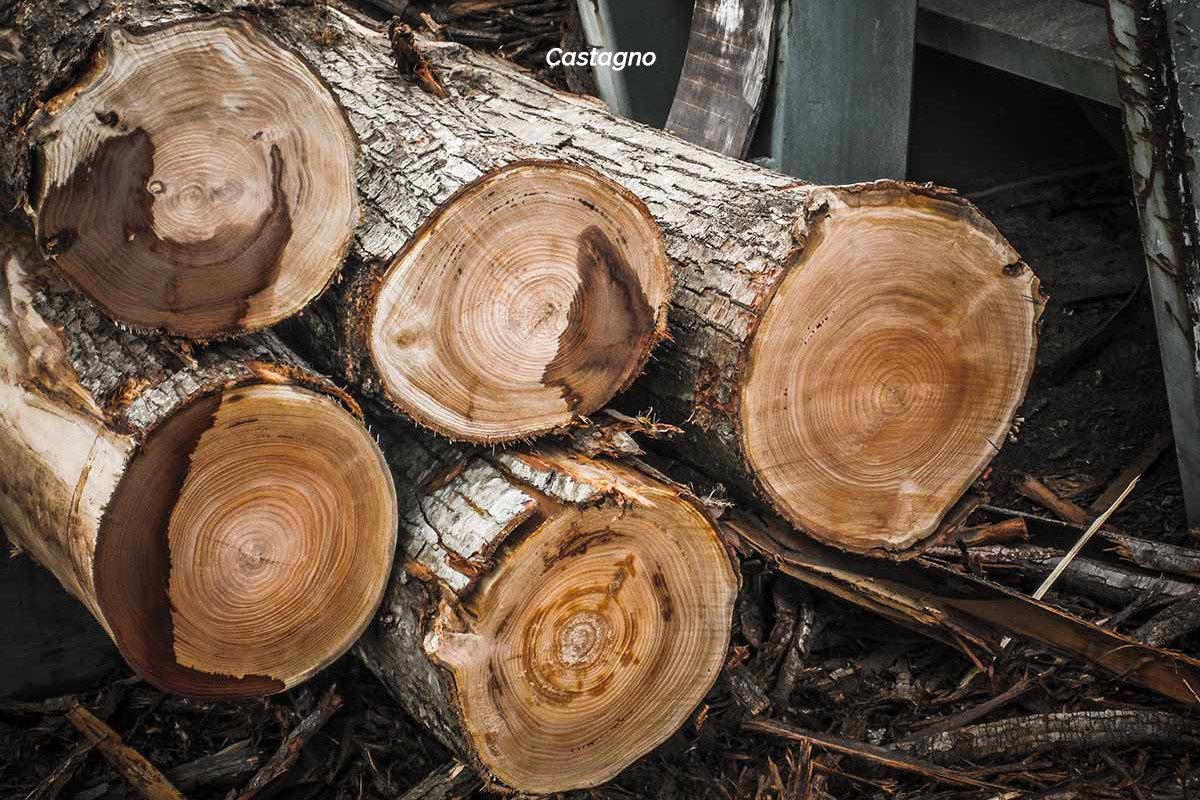


CHESTNUT
Timber for construction. Sawwood, but also ...
Calligaro Category: Building material
ART. CHESTNUT- Nat. - European
Request original sample.
Photos and colors of the samples are for information only.
FINISH: MATT
FEATURES:
Nominal thickness
Specific weight
on request Lamellar beams
Dimensions
- Massive beams
- 10 x 10
- 15 x 15
- 20 x 20
- Maximum length 13 m
STANDARD SIZE 3050 X 100 mm
Are you looking for Chestnut wood for structural use?
Chestnut Wood: Characteristics and Applications
Lightweight and strong
Chestnut is a precious, light and resistant wood. It is a semi-hard essence with a dense grain, not perfectly easy to work, which does not always ensure excellent results with regard to the various processes, such as cutting, planing, etc. It is a wood that is particularly suitable for making window frames, thanks to its marked resistance to humidity and atmospheric agents.
Thanks to its good durability and low shrinkage and hygroscopic coefficient, it is used in both indoor and outdoor joinery, in particular for: rustic solid wood fixtures and furniture, from the kitchen to the sideboard; beams, stilts and poles for agriculture, once used for electrification; garden furniture, from the gazebo to the pergola, from the fences to the picnic corner furniture.
The chestnut, apart from the aesthetic value for a rustic environment such as the garden, is a wood that is not afraid of humidity, resistant to atmospheric agents, made to be outdoors, (resistance and durability are properties supported by tannic acid present in the fibers, from the bark to the internal structure), which does not require special protective treatments and maintenance interventions; barrel daggers; cabinetry, for the realization of intaglfati objects; building structures, floors, trusses, roofs, roofs, porches, mezzanines, prefabricated buildings.

Paleria: Always at the service of man
Even today, the poles represent an important commercial outlet for chestnut wood, for use in vineyards and orchards, for stakes in arboriculture and nurseries, for fences and overhead lines.
- Stakes and fences: diameter 2-15 cm, length 1-2 m
- Vineyard poles: diameter 8-15 cm, length 2-4 m
- Orchard poles: diameter 10-18 cm, length 2-5.5 m
- For overhead lines (electric and telephone): diameter 15-30 cm at the tip, length between 8-18 m
Naturalistic engineering
In support of the territory: In the techniques and works of prevention of hydrogeological instability, maintenance and consolidation of slopes, extensive use is made of chestnut wood for its intrinsic qualities that make it particularly suitable for the purpose.
- Poles for simple piling
- single and double wall, gratings and grates
- diameter 20-30 cm, minimum length 3 m
- with or without bark.
Carpentry
A tradition that looks to the future: joinery boards are mainly intended for the production of furniture, outdoor furniture, solid wood panels, elements for doors and windows, interior and exterior cladding and flooring. The market also offers veneers for the finishing of support panels intended for furnishing accessories.
- Boards: thickness from 22 to 80 mm; various lengths, hardly more than 3 m
- Veneers (sliced): thickness 0,6 mm; various lengths, generally between 2 and 3.1 m
Parquet and windows
From nature, to arouse emotions: In some Italian regions, chestnut wood is traditionally used for the production of parquet and windows, where it is appreciated for its decorative aspect.
Chestnut wood has a limited surface hardness that requires suitable finishes to improve its behavior to wear and foot traffic. The pleasant decorative appearance and good stability therefore make it highly appreciated and sought after for creating multiple types of floors that they range from solid to pre-finished and are compatible with the different laying methods (nailed, glued, floating). Furthermore, in some Italian regions, chestnut wood doors and windows can in effect be considered an expression of the local building tradition.
Construction timber
“Rectangular section” structural timber: Historically, chestnut wood has been widely used in carpentry applications in Italy and Europe, especially for supporting roofs. This is evidenced by the supporting structures of many works of rural architecture and numerous historic buildings that are often the result of the craftsmanship of the past and are of interest to cultural heritage.
To date, chestnut is the only national hardwood for which mechanical strength values of rectangular-section timber for structural use are available, albeit with dimensional limitations, set by the EN 1912 standard.
| Category / Family / Name | Genus of the Fagaceae family. |
| Origin | Italy / France |
| Color | Narrow sapwood with yellowish-white color. |
| Weaving | Resembles oak in texture. |
| Mass (after seasoning) | - Lightweight (450 Kg / m2) |
| Durability | - Poor |
| Stability | ++ Fair |
| Machinability | ++ Good |
| Hardness | + Diesceta |
| Mechanical characteristics | - Axial 51 N / mm2, bending 110 N / mm2 |
| Gluing | +++ Great |
| Painting | ++ Good |
| Legend | - Poor - Moderate + Fair ++ Good +++ Excellent |
Other uses
Versatile and functionalIn addition to the aforementioned main uses, chestnut wood is used in the energy sector, for the production of containers for oenology up to the extraction of tannins.
ENERGY USE
Laminated chestnut wood: chestnut wood allows you to create a quality laminated wood with excellent mechanical and technological properties, resistant to external stresses and easy to work, used for classy windows and doors, able to enhance any environment from the rustic to modern to minimalist. Appropriately treated (stained), to imitate walnut in its various shades of color, precious wood much more expensive and less available, but also oak, a wood with characteristics very similar to its own, wenge, etc.
BARRELS
The production of chestnut staves for the construction of vats, barrels and barriques for wines and spirits represents a consolidated niche
Chestnut Wood: Characteristics and Applications
Lightweight and strong
Chestnut is a precious, light and resistant wood. It is a semi-hard essence with a dense grain, not perfectly easy to work, which does not always ensure excellent results with regard to the various processes, such as cutting, planing, etc. It is a wood that is particularly suitable for making window frames, thanks to its marked resistance to humidity and atmospheric agents.
Thanks to its good durability and low shrinkage and hygroscopic coefficient, it is used in both indoor and outdoor joinery, in particular for: rustic solid wood fixtures and furniture, from the kitchen to the sideboard; beams, stilts and poles for agriculture, once used for electrification; garden furniture, from the gazebo to the pergola, from the fences to the picnic corner furniture.
The chestnut, apart from the aesthetic value for a rustic environment such as the garden, is a wood that is not afraid of humidity, resistant to atmospheric agents, made to be outdoors, (resistance and durability are properties supported by tannic acid present in the fibers, from the bark to the internal structure), which does not require special protective treatments and maintenance interventions; barrel daggers; cabinetry, for the realization of intaglfati objects; building structures, floors, trusses, roofs, roofs, porches, mezzanines, prefabricated buildings.
Paleria: Always at the service of man
Even today, the poles represent an important commercial outlet for chestnut wood, for use in vineyards and orchards, for stakes in arboriculture and nurseries, for fences and overhead lines.
- Stakes and fences: diameter 2-15 cm, length 1-2 m
- Vineyard poles: diameter 8-15 cm, length 2-4 m
- Orchard poles: diameter 10-18 cm, length 2-5.5 m
- For overhead lines (electric and telephone): diameter 15-30 cm at the tip, length between 8-18 m
Naturalistic engineering
In support of the territory: In the techniques and works of prevention of hydrogeological instability, maintenance and consolidation of slopes, extensive use is made of chestnut wood for its intrinsic qualities that make it particularly suitable for the purpose.
- Poles for simple piling
- single and double wall, gratings and grates
- diameter 20-30 cm, minimum length 3 m
- with or without bark.
Carpentry
A tradition that looks to the future: joinery boards are mainly intended for the production of furniture, outdoor furniture, solid wood panels, elements for doors and windows, interior and exterior cladding and flooring. The market also offers veneers for the finishing of support panels intended for furnishing accessories.
- Boards: thickness from 22 to 80 mm; various lengths, hardly more than 3 m
- Veneers (sliced): thickness 0,6 mm; various lengths, generally between 2 and 3.1 m
Parquet and windows
From nature, to arouse emotions: In some Italian regions, chestnut wood is traditionally used for the production of parquet and windows, where it is appreciated for its decorative aspect.
Chestnut wood has a limited surface hardness that requires suitable finishes to improve its behavior to wear and foot traffic. The pleasant decorative appearance and good stability therefore make it highly appreciated and sought after for creating multiple types of floors that they range from solid to pre-finished and are compatible with the different laying methods (nailed, glued, floating). Furthermore, in some Italian regions, chestnut wood doors and windows can in effect be considered an expression of the local building tradition.
Construction timber
“Rectangular section” structural timber: Historically, chestnut wood has been widely used in carpentry applications in Italy and Europe, especially for supporting roofs. This is evidenced by the supporting structures of many works of rural architecture and numerous historic buildings that are often the result of the craftsmanship of the past and are of interest to cultural heritage.
To date, chestnut is the only national hardwood for which mechanical strength values of rectangular-section timber for structural use are available, albeit with dimensional limitations, set by the EN 1912 standard.
| Category / Family / Name | Genus of the Fagaceae family. |
| Origin | Italy / France |
| Color | Narrow sapwood with yellowish-white color. |
| Weaving | Resembles oak in texture. |
| Mass (after seasoning) | - Lightweight (450 Kg / m2) |
| Durability | - Poor |
| Stability | ++ Fair |
| Machinability | ++ Good |
| Hardness | + Diesceta |
| Mechanical characteristics | - Axial 51 N / mm2, bending 110 N / mm2 |
| Gluing | +++ Great |
| Painting | ++ Good |
| Legend | - Poor - Moderate + Fair ++ Good +++ Excellent |
Other uses
Versatile and functionalIn addition to the aforementioned main uses, chestnut wood is used in the energy sector, for the production of containers for oenology up to the extraction of tannins.
ENERGY USE
Laminated chestnut wood: chestnut wood allows you to create a quality laminated wood with excellent mechanical and technological properties, resistant to external stresses and easy to work, used for classy windows and doors, able to enhance any environment from the rustic to modern to minimalist. Appropriately treated (stained), to imitate walnut in its various shades of color, precious wood much more expensive and less available, but also oak, a wood with characteristics very similar to its own, wenge, etc.
BARRELS
The production of chestnut staves for the construction of vats, barrels and barriques for wines and spirits represents a consolidated niche


